
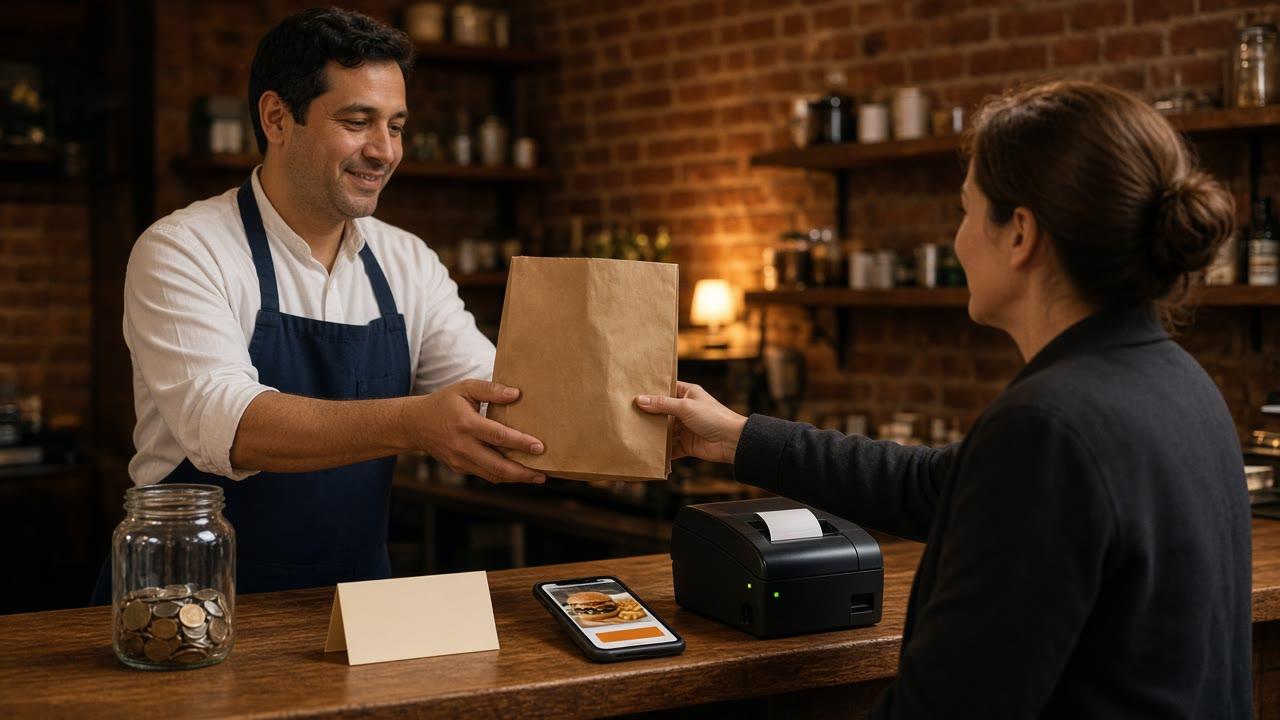
Should I tip for takeout is the question at the window. Takeout is not table service. The person who packed the order still did a job. Say which of those facts you want guests to act on, in a sentence they can read before they pay.
A collection counter that lives on pickup is the online ordering system for takeaway. A kitchen with no dining room, sending bags out the door, is cloud kitchen software. How the pass reads a ticket is how to run a kitchen in a restaurant. Stay here for the tip and the bag.
The honest answer for a diner
A diner who sat for an hour is in a different custom from a diner who collected a bag. Nobody carried plates or refilled a drink. Treating every takeout bag like a full-service check makes a small pickup feel like a trap.
Someone still did the work the guest cannot see. They read the ticket, checked the modifiers, sealed the container, wrote the name, and stood at the window. On a large order, a heavily modified order, or a bag packed with care, many diners leave 10 to 15%. On an ordinary pickup, many leave a smaller cash amount, or nothing, when they placed a simple order themselves. That is common practice. It is not a rule, and it is not a number from a survey.
A dining-room habit of 18 to 20% is a poor default for a bag at the window. If your shop wants a different number, say your number. Do not borrow a percentage and pretend a study required it. A driver is not the person who packed the bag. This page does not set a number for a driver.
Who does the takeout work
Name the job before you talk about the money. At a pizzeria it is boxing and checking toppings. At a cafe it is the cup and the name on the lid. At a kitchen that only does bags, it is the pack line from the pass to the door. The guest sees a handoff of a few seconds. The work started when the ticket printed.
If tips are pooled, say who is in the pool: packers, the expo, the window, or the cooks. If the owner is the only person on the counter and the tip stays with the owner, say that. Guests invent a story when you stay quiet, and the story is often wrong.
Say who the tip is for
A jar with no sentence is a guess. "Tips welcome for the pack line" is a policy. "Tips are not expected" is also a policy. Both are clearer than silence, and both are clearer than a screen the guest did not see coming.
Write the sentence the way you would say it to a regular. If you cannot say it at the window without apologizing, do not hide it on a bag sticker. The policy and the handoff should match.
How to state a tipping policy before the guest pays
Put one sentence where the guest can read it before the card goes through: on the menu, on the window, and on the bag. Use the same words in all three places. A guest who ordered on your site should not learn the policy from a jar on the way out.
Marketplace apps often put a tip screen in front of payment. DoorDash, Uber Eats, and Grubhub often charge 15 to 30% of the sale on top of whatever the guest adds. Your own site is where a regular should land. Do not assume a third-party screen will explain your shop.
Three policies you can say out loud
Tips are not expected. The menu price is the price. Say this if the pack work is already in the wage and you do not want a jar or a percentage.
Tips are welcome for the people who pack the order. Name them. A guest who leaves nothing should still get the same bag, with the same care.
Or give a house suggestion, such as 10 to 15% on large or modified orders, and a smaller cash amount on a simple pickup. Call it your practice. Do not call it an industry standard.
Checkout does not add a tip prompt
Published pages on this site say checkout does not add a tip prompt. Do not tell guests to look for a tip box on the MicroSky Food checkout, and do not advertise one. A tip jar, a menu line, or cash with the bag is a counter decision. It is not a checkout feature.
The bag still has to be right. Guests order on your domain from online ordering: modifiers, a running subtotal, and a pickup ready time before they pay. The paid order shows in restaurant admin and moves from new to preparing to ready. Ready means the bag is at the window.
Keep the takeout order accurate
A correct bag is the part of takeout etiquette you control. Each modifier belongs on the item as a button, with a price when the choice costs more. A note field will not survive Friday. The ticket can print on the receipt printer you already use, with the item, each choice on its own line, and a name.
Place one paid test and read the paper before you put the link on the window. If a new person on the pass would call the front to decode it, the modifiers are not done. Give that person a staff login that can 86 an item when the pan is empty. How it works is where the login is set up. The live demo is a storefront you can click first.
Saved cards, Apple Pay, and pay at pickup
Signed-in customers can pay with a saved card, and saved cards keep their billing address. Restaurants can let guests save a card, and they can optionally turn on pay at pickup. A regular who already has an account can sign in during checkout. That path is live checkouts and saved cards. It is a faster repeat order. It is not a tip box.
Apple Pay runs through Authorize.net on Growth and Growth Plus. Standard does not include Apple Pay. Cards otherwise run through Stripe, Authorize.net, or Electronic Payments. A $500 one-time hardware package includes a mini PC print server and a receipt printer if the shop has no print path.
A script for the window
Pick one policy and use it on the next shift. The guest should hear the same sentence the menu already printed. Then take the order on your site so the ticket matches the bag.
- One sentence guests can read before they pay.
- Who the tip is for, if you accept one, or a clear line that tips are not expected.
- The same sentence on the menu, the window, and the bag.
- No promise of a tip box on checkout.
- One paid test, then a ticket you can read at the pass.
What it costs to take the order on your site
On pricing, Standard is $249 per month plus 5% of net sales on online orders, or $499 per month flat. Only that flat Standard option leaves off the percentage. Growth is $499 per month plus 7% of net sales on online orders. Growth Plus is $999 per month plus 10% of net sales on online orders, after 3 months on Standard. A 30-day free trial does not replace those 3 months. There is no long-term contract.
The percentage applies to online orders. MicroSky Food takes no percentage of in-store sales. Marketplace apps often charge 15 to 30% of the online sale. Put the plan percentage next to that comparison.
What a takeout tipping policy will not do
It will not add a tip prompt at checkout. It will not decide the policy for you, pool the money, or tell you what to pay the pack line. It will not dispatch drivers or draw a geofence. A delivery-only kitchen that still needs its own ordering site is cloud kitchen software. The counter that lives on collection is the online ordering system for takeaway.
Restaurants already on the platform are on the clients page. Questions go through contact. Start 30 Day Free Trial. Call (888) 960-1359.